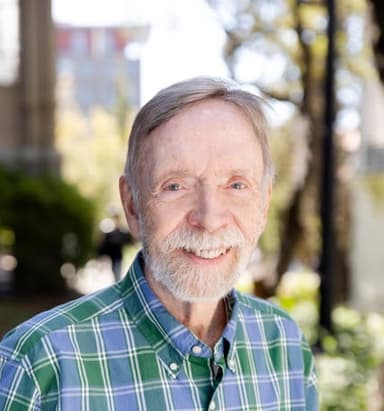
Frank Coyle
Lecturer, University of California Berkeley
University California Berkeley
@coyle_frankpFrank Coyle is a computer science educator with over thirty years of teaching experience, most recently as faculty at SMU and currently teaching Generative AI and Large Language Models at UC Berkeley and the University of Bologna. Frank is the founder of The AI Edge (codesupreme.ai), where he is launching Build to Certify, an eight-week cohort program preparing CS and engineering students for the Claude Certified Architect Foundations exam. His current focus is the practical craft of agentic AI engineering — tool design and MCP integration, context management, prompt engineering, and Claude Code workflows — taught through a hands-on "MAKE before explain" pedagogy. He is equally at home explaining tool-use loops to engineers and translating frontier AI concepts for audiences ranging from district attorneys to formerly-incarcerated students learning to code.
Sessions (2)
**Anthropic's CCA Exam: A Field-Guide for Agentic Engineering** The Claude Certified Architect (CCA) exam distills what Anthropic has learned from working with the AI companies shipping agents to production — the patterns that work, the anti-patterns that quietly burn tokens and trust, and the architectural decisions that separate demos from systems you'd stake a quarter on. This talk treats the exam as a field guide for agentic engineering, whether or not you ever sit for it. We'll walk through the five competency domains the exam tests — Agentic Architecture, Tool Design and MCP Integration, Claude Code, Prompt Engineering, and Context Management — with particular emphasis on multi-agent orchestration, subagent delegation, tool schema design, and lifecycle hooks. We'll then work through the six real-world scenarios the exam uses to probe judgment, each organized around an anti-pattern: the seductive-but-wrong move that looks reasonable until it costs you a production incident. Attendees leave with a working mental model of the agentic surface area and a checklist of the failure modes that matter most when moving from prototype to production. **Who should attend:** engineers and architects building agentic systems with Claude or other frontier models, technical leads evaluating agent designs, and developers considering the CCA credential.
Agentic systems fail in predictable ways: context degradation, brittle tool descriptions, fragile multi-agent handoffs, stop-reason confusion, and the ever-present temptation to fix reliability problems with more natural-language instructions. These anti-patterns aren't bugs to be patched turn by turn — they're symptoms of a missing architectural layer. LLMs reason probabilistically over domains they only partially understand, and no amount of prompt engineering fully closes that gap. This talk argues that the missing layer is an explicit ontology: a formal, shared map of the domain's concepts, relationships, and constraints. The pattern is not new — ontologies have driven commercial success in defense and intelligence systems for over a decade, where probabilistic models must operate over high-stakes enterprise data without drifting into nonsense. Graph databases like Neo4j and Amazon Neptune have made the underlying primitives widely accessible. We'll show how lightweight ontology constructs can surround an agentic system with enforceable logical constraints: typed entities and relationships that tools must respect, cardinality and domain restrictions that catch malformed tool calls before they execute, and a shared vocabulary that keeps coordinators and subagents talking about the same things. The session walks through several agentic applications — a multi-agent research workflow, a tool-heavy customer support agent, a coordinator-subagent delegation pattern — and shows in each case how an ontology layer addresses the kinds of anti-patterns catalogued in Anthropic's Claude Certified Architect exam. The result is a hybrid neurosymbolic architecture: probabilistic reasoning inside, logical guardrails outside. Who should attend: engineers building production agentic systems, architects evaluating reliability strategies beyond prompt engineering, and technical leads who suspect their agents need more structure than another system prompt can provide.