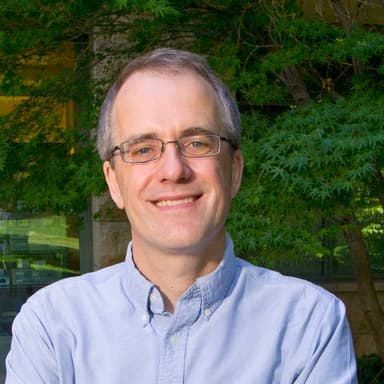
Christopher Manning
Distinguished Member of Technical Staff at Moonlake AI; Thomas M. Siebel Professor in Machine Learning at Stanford University; General Partner at AIX Ventures
Moonlake AI
@chrmanningChristopher Manning is the inaugural Thomas M. Siebel Professor in Machine Learning in the Departments of Linguistics and Computer Science at Stanford University, a senior fellow of the Stanford Institute for Human-Centered Artificial Intelligence (HAI), a Distinguished Member of the Technical Staff at Moonlake, and a General Partner at AIX Ventures. He served as the Director of the Stanford AI Lab (SAIL) 2018–2025. Chris is a pioneer in deep learning Natural Language Processing (NLP), work for which he has received three consecutive ACL Test of Time Awards and the IEEE John von Neumann Medal, and the most cited NLP researcher in the world. In 2025, he was elected to the National Academy of Engineering and the American Academy of Arts and Sciences.
Sessions (2)
What is the most important capability for world model applications and the pursuit of embodied AI? We believe it is not a question of having the most beautiful pixels but the ability to reason about causality in multimodal environments. At Moonlake, we are working on building action-conditioned multimodal world models which provide spatial and physical state consistency over long time periods. We believe that building and training on synthetic worlds provides the data and compute efficient path to truly useful world models. We are building the simulation infrastructure platform for companies that need to build and manage worlds (assets, scenes, digital twins) at scale, including robotics/autonomy teams, digital factory operators, and game authors. Our product today primarily finds applicability in simulation and the operationalization of digital twins. Simulation can include training robotics, world models for AGI research, autonomous vehicles, or content creation for media and entertainment. Operationalization of digital twins involves the reconstruction of scans into reusable assets, e.g., turning image and point-cloud scans into sim ready assets for digital factory Integration projects. We are building toward a future where AI systems do not just generate worlds, but understand how they work. Moonlake learns from each workflow: The more workflows, failures, and human interventions that Moonlake sees, the better it becomes at reconstructing, validating, and preparing complex simulation worlds. The session will include discussion and demos.
What is the most important capability for world model applications and the pursuit of embodied AI? We believe it is not a question of having the most beautiful pixels but the ability to reason about causality in multimodal environments. At Moonlake, we are working on building action-conditioned multimodal world models which provide spatial and physical state consistency over long time periods. We believe that building and training on synthetic worlds provides the data and compute efficient path to truly useful world models. We are building the simulation infrastructure platform for companies that need to build and manage worlds (assets, scenes, digital twins) at scale, including robotics/autonomy teams, digital factory operators, and game authors. Our product today primarily finds applicability in simulation and the operationalization of digital twins. Simulation can include training robotics, world models for AGI research, autonomous vehicles, or content creation for media and entertainment. Operationalization of digital twins involves the reconstruction of scans into reusable assets, e.g., turning image and point-cloud scans into sim ready assets for digital factory Integration projects. We are building toward a future where AI systems do not just generate worlds, but understand how they work. Moonlake learns from each workflow: The more workflows, failures, and human interventions that Moonlake sees, the better it becomes at reconstructing, validating, and preparing complex simulation worlds. The session will include discussion and demos.